

TUI / Enterprise design system
Independent products. One reusable language.
A reusable component system supporting TUI’s global rebrand across independently developed internal applications.
Inspect the framework- Client
- TUI
- Context
- Global rebrand across internal applications
- Role
- Senior Product Designer, Design Systems Designer & Front-end Developer
- Delivery
- Component library, documentation and front-end framework
System problem
A global identity met a fragmented product estate.
Multiple internal applications needed to adopt TUI Next, but their interfaces had evolved independently. Recurring controls and behaviours were being solved repeatedly, producing duplicated effort and inconsistent experiences.
The design-system work had to preserve the new brand language while remaining practical for teams assembling different products, data views and workflows.
Component architecture
Built from small decisions into complete products.
Atomic Design provided a useful organising model, but the system remained grounded in recurring product needs, documented behaviour and implementation constraints.
- 01 Foundations Brand, colour, typography and spacing rules
- 02 Components Controls and repeated interaction behaviours
- 03 Patterns Navigation, forms, tables and data views
- 04 Products Different applications assembled from shared parts
Framework in practice
Shared parts became a working product framework.
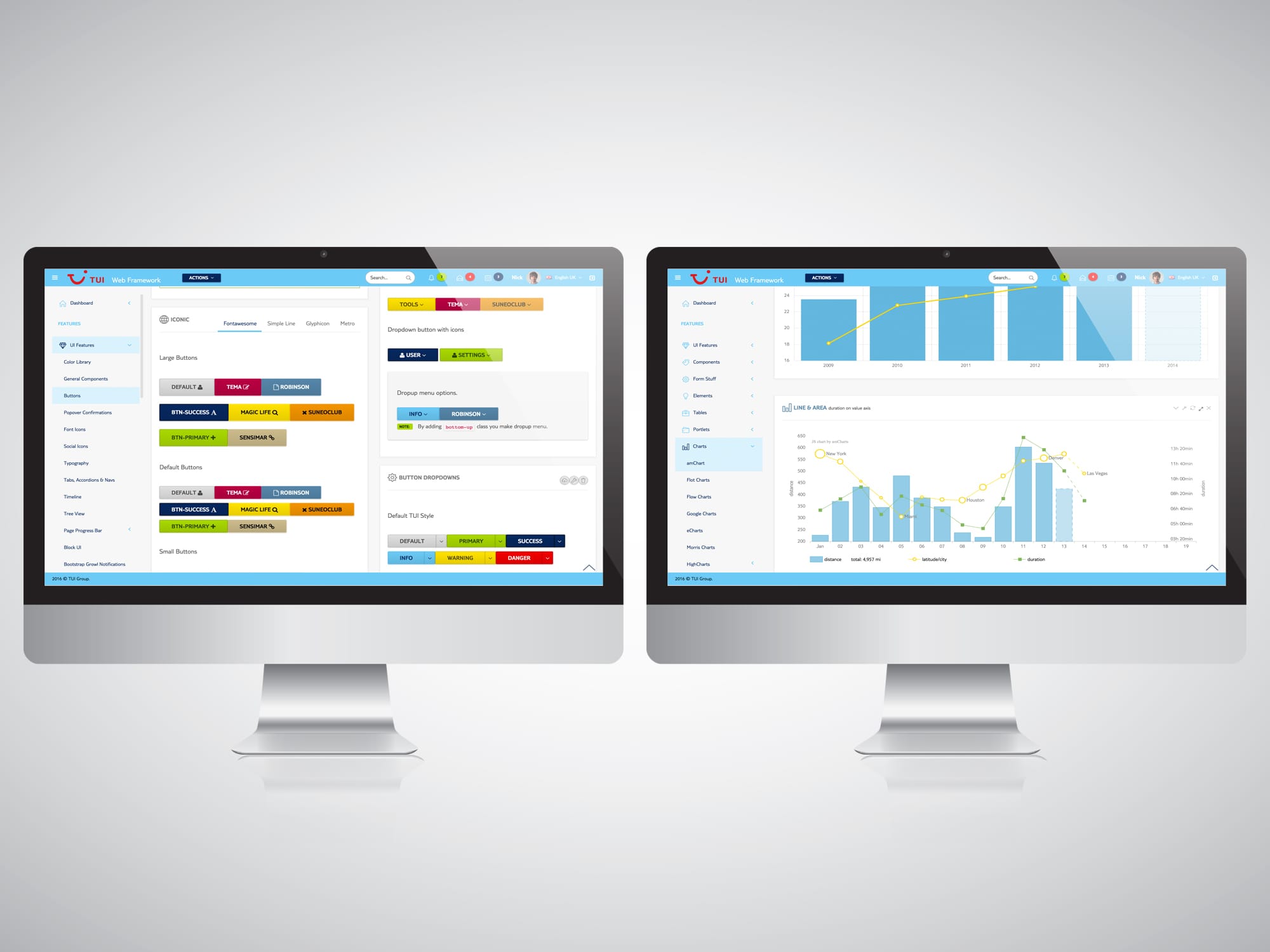
Reusable controls, navigation and data-visualisation patterns brought the component architecture into one inspectable environment that teams could apply across different internal products.
Decision register
Three decisions kept reuse practical.
The system needed enough control to create consistency and enough flexibility to support genuinely different applications.
- 01 Organise around recurring product needs. The system was not modelled around one application’s page structure.
Patterns were derived from repeated interface requirements, allowing the framework to support different product contexts.
- 02 Make documentation part of delivery. A component without behaviour and usage guidance was incomplete.
Documentation connected visual examples to intent, interaction and implementation expectations.
- 03 Separate consistency from uniformity. Shared foundations did not require every product to become the same page.
Teams could compose different workflows while retaining recognisable brand and interaction decisions.
Delivery trace
A framework designed to travel between teams.
- 01 Audit Recurring interface needs identified across products
- 02 Systemise Foundations, components and patterns organised
- 03 Document Intent, behaviour and usage made inspectable
- 04 Implement Responsive front-end framework prepared for reuse
Evidence boundary
Reusable UI patterns and a working implementation foundation were delivered.
The supplied evidence supports real-application reuse. It does not provide quantified adoption, delivery-speed, productivity or maintainability gains, so none are claimed.
Implementation perspective
Reuse had to remain practical for developers.
The framework was not only a visual system. Its value depended on collaboration with the developers who had to implement and extend it.
“Michael has always collaborated on his work with developers to ensure it fits the requirements and allows for easy implementation.”
Read full testimonial
Michael is the UX Designer CIO at The Content Hub and is responsible for user experience designs across the majority of the projects; often working on multiple projects at once, never failing to deliver amazing solutions. Michael has always collaborated on his work with developers to ensure it fits the requirements and allows for easy implementation. His work has always impressed our customers, who often asked why solutions from other parts of TUI don’t have as good a look and feel and how he managed to achieve it. Even though Michael’s job was to create designs, it didn’t stop him from exploring other areas of development, and he has done an amazing job learning JavaScript and jQuery to deliver complex solutions. In the last few days of working for TUI he has even started learning Angular. During the development cycle, Michael gave a lot of constructive criticism and analytical feedback on the solutions, which has helped The Content Hub to deliver better products. Working with Michael has always been a pleasure as he is always happy to assist with any issues or questions, often finding new, better ways.
Next case study
TUI 360° / Aircraft Experience
Need one system to support different products?
Tell me where inconsistency is creating friction and what your teams need to deliver repeatedly.
Start a conversationI usually respond within two working days.